For boards, investors & leadership teams
Your organisation runs hundreds of meetings a week. Execution Intelligence hears all of them.
Every week, your organisation generates hundreds of hours of meeting data. Inside that data: strategic drift, escalating risks, broken information flows, and decisions that never get made. Execution Intelligence extracts what matters — automatically, continuously, objectively.

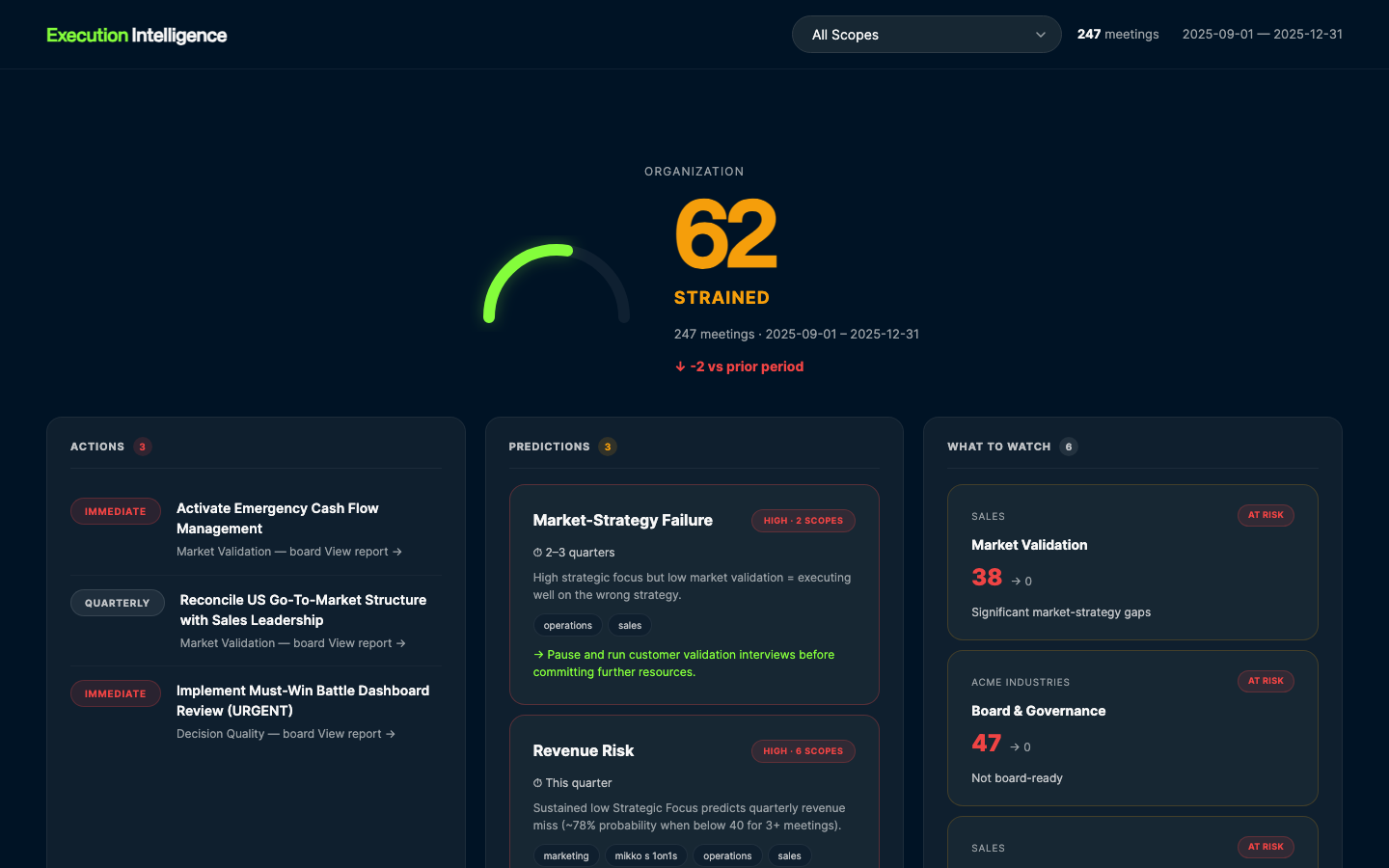
500+
meetings analysed
40+
teams scored
10
diagnostic lenses
<48h
to intelligence
The execution blind spot
You’re governing by narrative,
not by evidence.
Organisations make critical decisions based on three sources: board packs curated by the people being evaluated, engagement surveys that are self-reported and infrequent, and gut feel that is subjective and unscalable.
Board packs
Curated fiction
Optimised for optics, not truth. Written by the people being evaluated.
Employee surveys
Self-reported sentiment
Politically filtered, 12 months stale by the time they’re acted on.
Consultant interviews
Performed narrative
€200–500k, 6–12 weeks, and people perform for the interviewer.
Your direct experience
3–4 meetings per week
Out of 300+ happening across your organisation. You’re governing from a sample size of 1%.
Meanwhile, the truth about how your organisation actually operates lives in thousands of meeting hours that nobody analyses. The data was always there. Nobody was listening.
The 10 lenses
Evidence-based scoring across four dimensions.
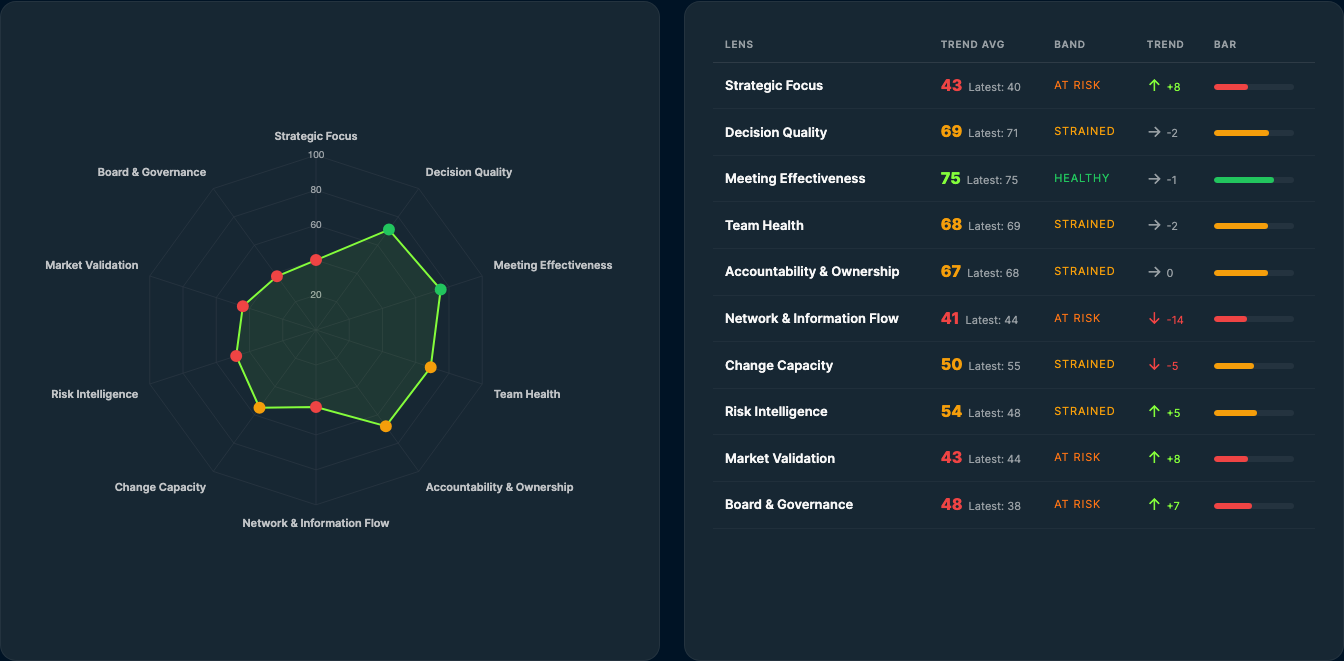
Each lens measures 5–8 independent dimensions, scored 0–100 with interpretive bands. Every finding is traced back to specific evidence in specific meetings.
Strategy
Strategic Focus
Is your strategy actually driving daily decisions?
What it catches
Teams executing brilliantly on the wrong things. Strategy documents that exist but never enter the meeting room.
Market Validation
Does market reality match your strategy?
What it catches
Compensation structures that contradict strategy. Market signals in sales meetings that never reach the strategy team.
Execution
Decision Quality
Are decisions made with data, ownership, and timelines?
What it catches
Decisions avoided, made without data, or made by the wrong person. Meetings that feel productive but produce no actual decisions.
Meeting Effectiveness
Do meetings produce outcomes or just fill calendars?
What it catches
Meetings without agendas, without outputs, or with the wrong people. The difference between coordination and activity.
Accountability & Ownership
Are commitments being tracked and honoured?
What it catches
Action items that evaporate between meetings. Accountability that concentrates on one person until they become the bottleneck.
People
Team Health
Is the team psychologically safe and dynamically balanced?
What it catches
Silent disengagement, dominant voice patterns, eroding trust. The dynamics that engagement surveys miss because people self-censor.
Network & Information Flow
Does information reach the right people in time?
What it catches
Three teams solving the same problem independently. Critical data trapped in one scope while another scope needs it urgently.
Change & Capacity
Can the organisation absorb what it is planning?
What it catches
Restructuring during peak delivery. Cost-cutting that removes the capabilities needed for survival.
Risk & Governance
Risk Intelligence
Are risks identified, escalated, and mitigated?
What it catches
Risks mentioned once and never followed up. Escalation curves that are invisible meeting-by-meeting but unmistakable over time.
Board & Governance
Is governance evidence-based or ceremonial?
What it catches
Information that reaches the board 3–4 weeks after it was visible in team meetings. Governance gaps that create fiduciary risk.
How it works
Four steps. Zero surveys.
Continuous intelligence.
01
Record
Our meeting bot joins your Zoom, Teams, or Meet calls automatically. No hardware. No special setup. Your team meets as usual.
02
Extract
AI extracts 9 structured signal types from every transcript: decisions, action items, risks, dependencies, escalations, opportunities, and more.
03
Diagnose
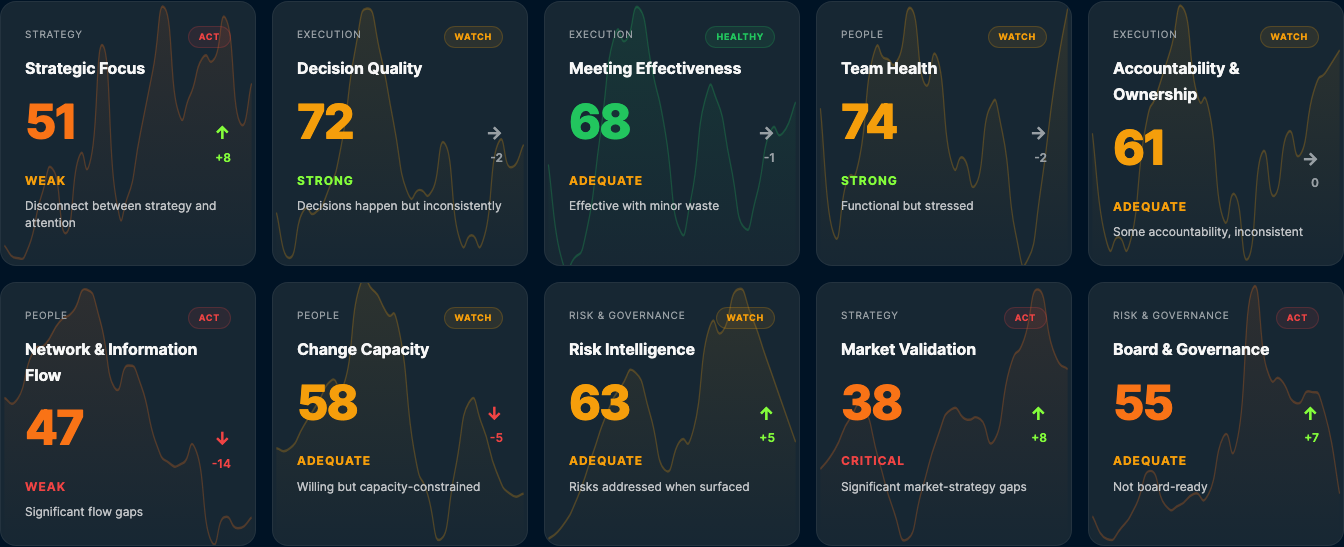
Every meeting is scored across all 10 diagnostic lenses. Each score includes confidence levels, severity ratings, evidence from the transcript, and recommended actions.
04
Track
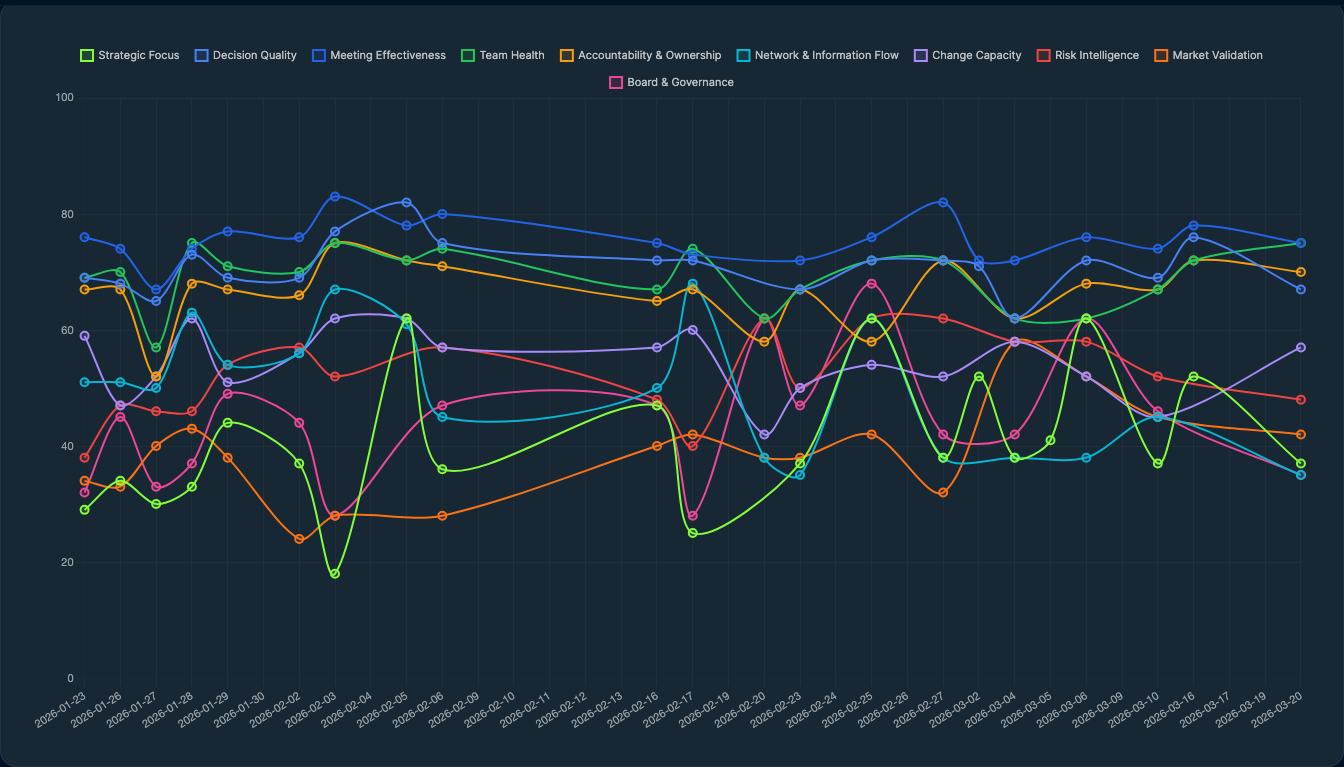
Individual meeting scores are useful. But the longitudinal view is where intelligence emerges. Track how scores change over weeks and months. Detect escalation curves and structural patterns before they become crises.
Proof case
“I didn’t know our strategic framework was never referenced in any meeting. I assumed it was happening.”
— CEO, PE-backed industrial scale-up
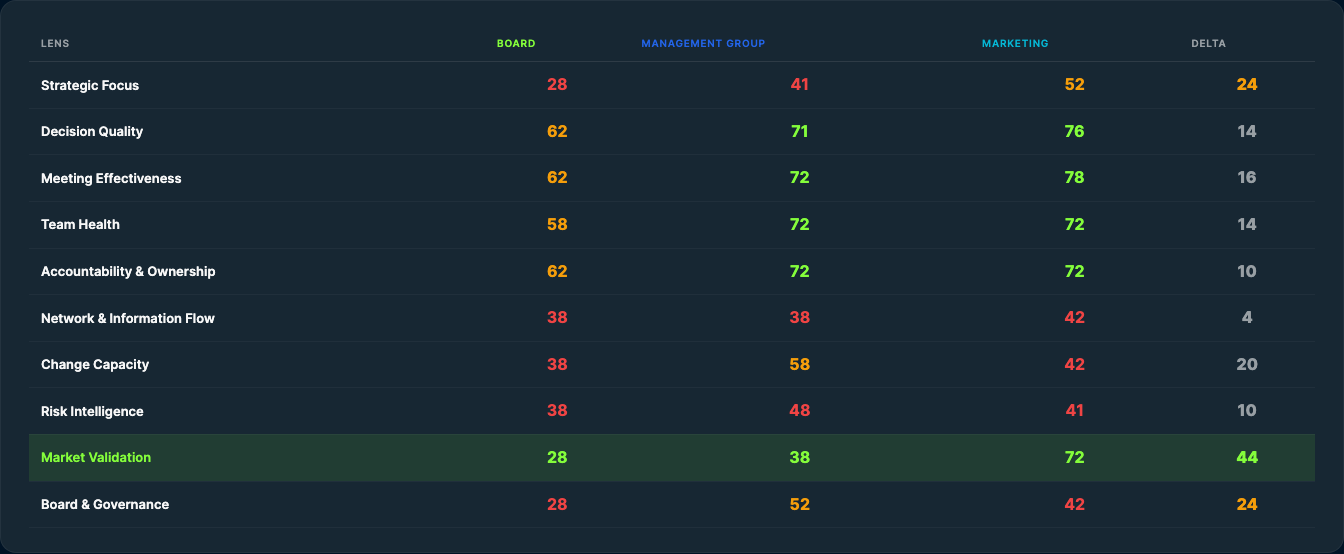
A PE-backed industrial scale-up engaged In Parallel to analyse 4 months of meeting recordings across every function: board, management, sales, marketing, operations, R&D, and CEO direct reports. 100+ meetings. Every team. 10 lenses. One truth.
0%
of meetings referenced the strategic framework
Strategy existed on paper only. Not one team in any scope mentioned the declared strategic priorities. Not once.
8 / 100
Partner Channel Commitment score
Compensation structurally incentivised direct sales. Every salesperson was rationally undermining the declared strategy.
83%
customer installation problem rate
A quality crisis escalated invisibly across 8 weeks. Each meeting treated it as new information.
100%
of scopes had CEO as named dependency
The CEO appeared as owner, decision-maker, or critical dependency in every organisational scope simultaneously.
0
customer mentions of stated differentiator
The declared market differentiator had zero validation in customer-facing meetings. Customers buy for different reasons entirely.
Time to produce this analysis: under 48 hours.
A traditional consulting diagnostic covering this scope would take 6–12 weeks and €150–300k.
Who it’s for
The same intelligence.
Different questions answered.
Execution Intelligence surfaces different signals depending on what you need to know. Choose your role to see what it means for you.
Investors & board members
Board packs tell you what management wants you to know.
Portfolio visibility, early-warning intelligence, governance enhancement, and due diligence augmentation.
See how it worksChiefs of staff & strategy leaders
You can sense when something is off. Now you can prove it.
Continuous execution radar, cross-scope pattern detection, and strategy-to-execution tracking.
See how it worksPeople & culture leaders
Engagement surveys measure sentiment. Meetings measure reality.
Behavioural team health, leadership development evidence, and culture measurement from actual meetings.
See how it worksEngagement models
Intelligence, not software.
Execution Intelligence is an organisational diagnostics capability, not a seat licence. Pricing reflects the scope of intelligence delivered, not the number of users.
One-time
Strategy Validation Package
Stress-test a strategy against 3–6 months of meeting data. Full 10-lens diagnostic, longitudinal analysis, CEO dashboard, and strategy stress-test report. Delivered in 48 hours.
Book a diagnosticSubscription
Continuous Monitoring
Ongoing 10-lens diagnostics on every meeting. Real-time dashboard, weekly digests, threshold alerts, and quarterly deep-dives with your leadership team.
Talk to usAnnual
Annual Partnership
Full-year engagement with monthly dashboards, quarterly deep-dives, board-ready reporting, and advisory sessions. Make execution intelligence a permanent capability.
Talk to usEnterprise
Portfolio Intelligence
Multi-company deployment with cross-organisation benchmarking. Standardised scoring across your portfolio. For PE firms and enterprise groups.
Request a portfolio briefingThe methodology
Continuous behavioural diagnostics from organisational conversations.
Our framework draws on three established research traditions: discourse analysis in organisations, sensemaking theory, and behavioural strategy. The analytical chain follows a structured progression from raw transcript to strategic recommendations.
Signal extraction pipeline
Nine signal types extracted from every meeting
action_item
"Lisa will share the revised timeline with the team by Thursday"
decision
"We agreed to postpone the product launch to Q3"
obstacle
"The platform migration is blocked — the vendor hasn't delivered the API"
escalation
"We need to raise the delivery risk at the next board meeting"
dependency
"We can't start testing until the infrastructure team signs off"
risk
"If we lose this contract, we won't hit our revenue target"
opportunity
"The new enterprise prospect wants a pilot for 200 users"
learning
"Customer churn data shows onboarding is the primary drop-off point"
progress_update
"Pipeline in the Nordic region doubled since last quarter"
Scoring calibration
We deliberately avoid score inflation. A “50” means “middle of the road” — not “failing.” Most healthy organisations score 55–75 on most lenses. Scores above 85 are genuinely exceptional.
| Score | Band | Meaning |
|---|---|---|
| 90–100 | Exceptional | Top-decile practice; rare even in high-performing companies |
| 75–89 | Strong | Healthy organisation with normal areas for improvement |
| 55–74 | Adequate | Functioning but with visible gaps; typical for most organisations |
| 40–54 | Weak | Significant issues impairing execution; intervention needed |
| 20–39 | Critical | Dysfunction actively destroying value |
| 0–19 | Broken | Fundamental absence of the capability being measured |
Built on established research
Discourse analysis
Organisations are constituted through language. Strategic priorities, power structures, and cultural norms are enacted and reproduced in everyday talk.
Fairclough, 2003; Grant et al., 2004
Sensemaking theory
When a CEO articulates a strategic priority but the team never references it, the strategy has failed at the sensemaking stage — before execution even begins.
Weick, 1995
Behavioural strategy
Strategic decisions are shaped by cognitive biases, social dynamics, and organisational routines. These patterns are observable in meetings but invisible in traditional reporting.
Powell et al., 2011
Questions we hear
Frequently asked questions.
How do you handle privacy and data sensitivity?
All meeting participants are notified that the meeting is being recorded. Diagnostic reporting is at the team/scope level, not individual level. Data is processed and stored in the EU. You control data retention and can delete data at any time. We provide a full Data Processing Agreement (DPA) and are GDPR-compliant.
What about meetings in Finnish, German, or other languages?
Our transcription supports 50+ languages. The diagnostic lenses are currently optimised for English, Finnish, German, and Swedish. Multilingual meetings — where participants switch between languages — are handled natively.
How accurate are the diagnostics?
Each diagnostic finding includes a confidence level (high, medium, low) and the specific evidence from the transcript that supports it. We do not report low-confidence findings as high-severity.
Will my team feel like they are being surveilled?
We position Execution Intelligence as a meeting quality and organisational health tool, not a performance monitoring tool. Diagnostics score meetings, not people. The most common team reaction is curiosity, not resistance.
How is this different from Otter, Fireflies, or other meeting tools?
Transcription is a commodity. Those tools tell you what was said. Execution Intelligence tells you what it means for your organisation’s health. The 10 diagnostic lenses, longitudinal tracking, and cross-scope pattern detection are capabilities that no transcription tool offers.
How long does the initial diagnostic take?
For the Strategy Validation Package (analysing existing recordings), we typically deliver findings within 48 hours of receiving access to meeting data. Our proof case analysis of 100+ meetings across every organisational scope was produced in under 24 hours.
What meeting platforms do you support?
Zoom, Microsoft Teams, and Google Meet. Our meeting bot joins scheduled meetings automatically — no special hardware or setup required.
What if we don’t have historical recordings?
No problem. We start recording from day one and begin delivering diagnostics within 2–4 weeks as meeting data accumulates. The longitudinal intelligence becomes more valuable with each passing week.
The truth is already in your meetings.
Let’s find it.
Share 5 recent meeting recordings. We run all 10 diagnostic lenses on your meetings. You see real scores on real meetings — in 48 hours.
No commitment. No integration needed. No IT project.